
Satellite Internet as a Backup Line: Does Starlink Make Sense for Your Business?
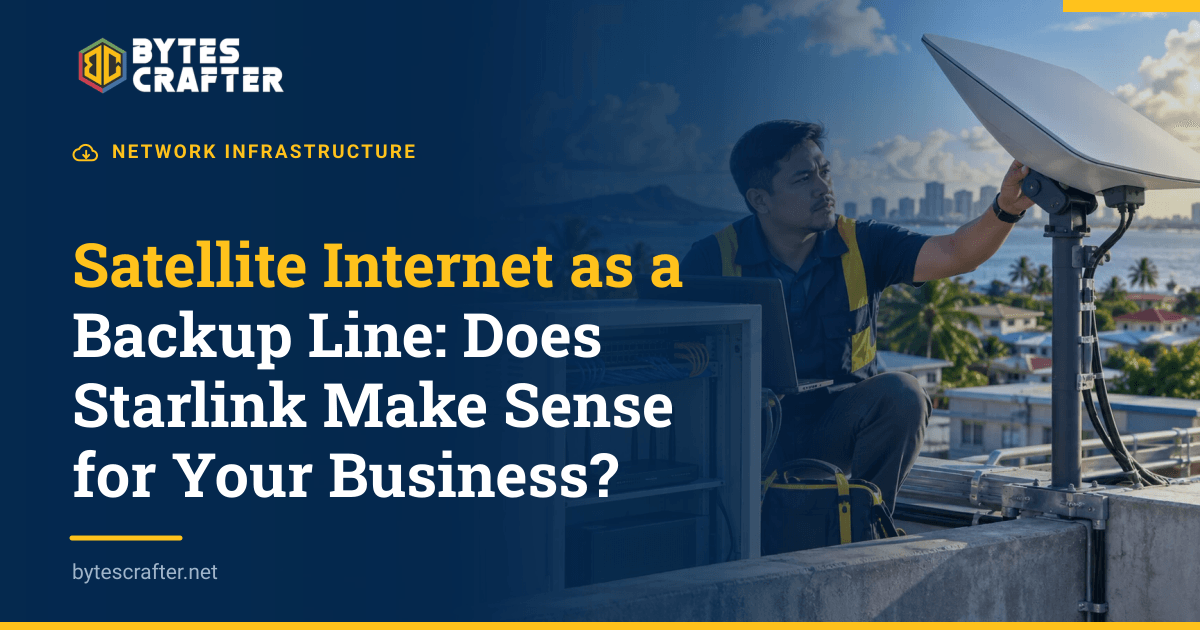
Is Starlink for business in the Philippines a sensible second connection? Picture a small Laguna distributor whose order desk, cloud inventory, and supplier messages all depend on one fiber line. A satellite dish may give that office a different physical path to the internet. Whether it is worth buying depends on the site’s sky view, power, work that must continue during an outage, and the actual cost of downtime. We would assess those details before selecting a provider or equipment.
What Starlink changes for a Philippine site
Starlink uses low-Earth-orbit satellites to connect a ground dish to its network. Its local appeal is path diversity: a fiber line enters through poles or ducts, while the dish communicates with satellites overhead. That can reduce dependence on the street-level route that carries a wired connection. It does not remove dependence on the building’s power, router, and Starlink’s own network.
The Philippine policy backdrop also changed. Republic Act No. 12234, the Konektadong Pinoy Act, dates from August 2025 and establishes an open-access framework for data transmission providers, including satellite participants. The law addresses provider registration and satellite access; it does not promise that a particular business will receive a cheaper plan, a licensed local installer, or an uninterrupted signal. Compare offers available at your exact address instead of treating a policy change as a service guarantee.
PLDT Enterprise announced a Starlink reseller arrangement, explicitly discussing backup connectivity for businesses. That is one procurement route to compare with direct service and other lawful offers. Ask each seller who supplies the hardware, installs the mount, owns the account, provides support, and handles replacement during a failure. Our network consulting service can help turn those answers into a site-specific network design.
Compare Starlink with a second fiber line
“Starlink vs fiber Philippines” is not one nationwide speed contest. Fiber is often an excellent primary connection when it is stable at your address. A second wired service may be a practical standby line if it uses genuinely separate last-mile infrastructure. Ask the providers where their cables enter the property, whether they share the same pole or building riser, and whether both depend on one powered cabinet nearby. A different bill logo does not prove a different failure path.
Starlink avoids some local cable damage but introduces other constraints. Trees, nearby buildings, and roof structures can obstruct a dish. Starlink’s installation guide instructs users to check for a clear sky view and use its app to assess obstructions. Inspect the proposed location before ordering. Include permission to use the roof, safe cable routing, a secure mount, and access for maintenance in the plan.
| Site question | Second wired line | Starlink |
|---|---|---|
| Physical path | Verify separate poles, ducts, and entry point | Verify unobstructed sky and mount |
| Local storm damage | Check whether both cables share exposure | Check roof safety and post-storm access |
| Building power | Modem, router, and switch still need power | Dish, router, and switch still need power |
| Commercial terms | Installation, monthly fee, support and repair | Hardware, installation, monthly fee, plan limits and support |
| Best evidence | Route details and a failover test | Site survey and a failover test |
Do not infer that either option will always win. The useful comparison is how each behaves during the failures your particular business is likely to face.
Account for rain, power, and provider outages
Satellite connectivity has a weather limit. Starlink’s mounting guide says heavy rain or wind can slow service or cause an outage. In a severe storm, a dish also needs to remain safely mounted and powered. An uninterruptible power supply or generator plan should include the dish, its power supply, the failover router, network switch, and any computer that staff need to work. Size backup power from measured equipment draw and the outage period you must cover.
The provider itself can fail. Network monitoring company ThousandEyes observed a roughly 2.5-hour global Starlink outage on July 24, 2025. The lesson is operational: a satellite connection diversifies the physical access path, but it is still one commercial network. Decide which work must pause or run offline if both connections fail. Do not promise “zero downtime” in a purchase proposal.
For a hypothetical warehouse near a Laguna industrial park, order entry and customer messages might be essential, while large software downloads can wait. During a fallback period, route only priority business traffic through the second connection if the purchased plan has limits. Confirm those limits with the actual provider offer; plan terms and pricing can change.
Run a small cost and fit worksheet
Estimate the cost of a normal connectivity outage from your own records. Keep the assumptions visible:
| Input | Your figure |
|---|---|
| Hours the primary link was unusable in the last year | |
| Sales or productive work delayed per hour | |
| Work recovered later versus permanently lost | |
| Hardware, roof work, and installation | |
| Monthly plan and support cost | |
| Power backup and periodic test cost |
Avoid multiplying every lost hour by total daily sales; delayed work may be recovered. Ask operations and finance which transactions actually failed, what staff could do offline, and whether the business paid for urgent workarounds. Use those answers to compare a second wired line, Starlink, and process changes. No generic peso figure can replace your own downtime record or a current written quotation.
Starlink may be a stronger candidate for a site with only one viable cable route, a clear roof, reliable backup power, and transactions that cannot wait for street repairs. A second independent wired route may suit an office with accessible infrastructure and a lower monthly cost. If neither path is affordable, even an offline order procedure and a mobile contact channel can reduce disruption.
Prove the setup before relying on it
Start with one site and a written test. Record baseline speed and application behavior on the primary line. Configure the router to detect a real connectivity failure, then disconnect the primary link under supervision. Check whether staff can reach the order system, send messages, and complete a payment or invoice workflow without duplicate transactions. Restore the primary link and verify the return path. Repeat during a normal work period, and document who receives alerts and who calls each provider.
The test should also cover a power interruption and an application session that does not reconnect cleanly. Automatic failover is helpful, but its timing depends on equipment, settings, and the application. Measure your result rather than advertising a fixed number of seconds.
If you want us to assess the site and compare connection options, request an estimate with your current providers, roof constraints, critical applications, and outage history. We can scope the network assessment and a practical failover acceptance test.
Related Stories

Never Fully Offline: Dual-WAN Failover Setups for Zero-Downtime Businesses
One failed internet line can stop cloud POS, online orders, video calls, and branch systems at the same time. A second subscription helps only if someone can switch traffic to it q…
One Flat Network Is a Risk: Network Segmentation for Small Offices
A Laguna office can have a fiber modem, one Wi-Fi password, and a rack full of equipment yet still have almost no boundaries inside its network. The cashier's point-of-sale termina…

Beyond the Punch Clock: Wiring Biometric Attendance Into Your Payroll Software
A fingerprint scanner at a Laguna factory gate can record arrival punches while payroll still depends on someone copying times into a spreadsheet. The device and payroll software o…